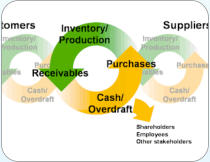
Working Capital as Barometer of Efficiency
Call us or send us a Mail -
we woudl be glad to answer your questions!


Working Capital is a highly efficient barometer for measuring a companies operating efficiency and effectivity. As better the conditions are, as more the corporate is able to concentrate on its core-business instead of
asking banks and shareholders for more capital.
The first shots to maximize cash management have their roots in the beginning 70’s of the last century. But
also today, almost 45 years later, some companies don’t recognize that “tied capital” in the current assets
could be better used to run a successful business vs. their competitors in the highly competitive market.
There are clear indicators that this important topic became now also attantion not only in the financial
departement, also in the awareness of the CEO. So far the survey-results of large consultant firms.
Current results show an ongoing decrease of working capital in US- and European corporates. In comparison to former years it monitors a
decrease between 3% and 5% what means, it has improved. This demonstrates the increasing importance of working capital management that
corporates can better achieve their strategic results (source: T. Loneux, REL Consulting).
While the improvements in Europe where larger than in the USA, the trend shows that in general a softening of growth. This is a result because
traditional methods come to an end to generate value. Hence, this leads corporates to think also outside established processes and the increasing
efforts of unfreezing liquid parts of the balance sheet with creative new methods.
Course of Action
Advisory in the working capital management means not only to tell a company that their debtors need to be forced for utmost fast payment or to
delay the vendor payments as much as possible and, last but not least, decrease the inventory turnover to the smallest possible value (days), i.e.
increase it to its maximum. A well understood and managed program for improvement concentrates without doubts on optimizing every single part
of it. But it shall provide additional benefit which is going far above “normal” operational action. It shows the necessity of ambitous companies to
integrate working capital management in the strategic and tactical thinking, instead investing time and money in cost-optimizing projects which
results at the end of the day in marginal profits - if so.
There are numerous "dos" and "don'ts" which help to drive management thinking. First, think on working capital management as strategic goal
which can achieve strategic operational goals of your company. This is a very important step and need to be absolutely respected. The same
triggers which affect working capital management, affect also your operational costs and customer services. As a consequence that it contains als
the components of working capital, it is direct related to improve the operational costs and the customer and vendor service.
For example the working capital of a company worses in case of increase of overdue receivables of your customers. Now, if customers do not pay
in time it has mostly a specific reason which can often be considered as disaffection. So, the question is now, why the customers are not
satisfied. An individual solution for many single open- and still customer complaints takes in average 30 days time. By trying to get to the bottom
of the disaffection you can find out, whether it is the price and/or the quality of the products or whether it is the customer service which leads the
customer to pay too late. This leads to less tied time of your sales staff, in the order process and in the account receivables department. These
persons can now invest more time in their core business, i.e. selling products, enter orders into the system and lean accounting of cash collections.
In consequence, the productivity increase, the operational costs reduce and the sales maximize. And this all, because the focus was to optimize a
balance sheet number called working capital and the project was to ask for the reasons why customers do not pay their invoices in time.
This example monitors, how working capital is one of the best indicators of underlying economic inefficency within an organisation. Due to this
reason it is quite important that the upper management concentrate on the analysis of basic problems in working capital to manage the operational
costs better and to stay competitive in the market. Some further ideas which are described below could be broader to support the success.
Review from another point of view
Don’t think on things only from the point of view in your own company. If you could help your customer to plan his warehouse more efficient, you
could for example merge this improvement with the need of the customers of your customer and increase so your sales. Do this in the same matter
and cost efficient with your own supplier. The optimization possibilities for inventory are huge. Because you
adjust inventory, production- and distribtution processes, you increase the related performance and achieve
immediately direct cost reduction as side effect. Just after this discuss with your supplier and customer better
ways of delivery conditions. Learn your organisation to make compromises between the different wishes of
your customers and suppliers and consider them as direct related. Depending on the demand of a specific
commodity it can be for example very attractive for both parties (you and the supplier), to arrange a
consignment stock and get in contrary better settlement conditions. This could be especially possible for goods
which have a long production time and request high minimum order quantities. Same criterias can be adapted
for a customer. Is it possible that a vendor driven stock could help your customers to match his purchases
exactly to his consume in order to optimize a better plan for the production? However, it need to be considered that this is not always possible for
all products and need to be analysed from case to case.
Negotiate formal Sales Conditions
Negotiate formal sales conditions with vendors and customers and documentate them very carefully. Keep them always up to date and take care
that, without any exempetion, all employees are informed about that. Especially those are responsible for purchase, sales and administrative
backoffice work (e.g accounts receivables / payables). Do not agree to introduce a new product without a clear product-offer management strategy.
Whether you are in the consuming goods industry or in the production of steel beams, today in the market many firms count always on new
products with the objective to keep their market share or to growth. The problem is that poor product offer management results in ineffeciency of
the supply chain. A common approach is also to support old products with large volumes on stock, which do not find any more demand. This
increases the operational costs dramatical and let the organisation suffer under long standing inventory volumes which need be eliminated. Did you
already calculated what is more expensive for you: loss of a sale or holding a specific number of goods on stock? (See also our mathematical
model to calculate the ideal number and read our article “Supplier Management”)
Collect your Cash
Don’t forgett to collect your cash. Many organisations introduce powerful and ongoing recivable management systems in order to prevent excess
and overdue cash or cumulation of old debtors. Ask your customers whether your invoices have been received and whether they are clear for
settlement. If not, notice the problems which prevent a payment in time. Confirm and reconfirm the credit conditions which have been agreed with
your customer (see especially for this topic our article Electronic Invoicing). The credit conditions are going to be often lost in the translation of
standard payment terms and what is given in the standard data of the account receivable general ledger. Dedicate the necessary time and
attantion for critical conflict management with customer complaints (quite and open). Keep all customer and vendor complaints in a formal way.
Debates with customers freeze cash, reduce productivity and lead to a poor service level.
Do not introduce top-down goals for all business processes overall. For example many companies have a target of a 10% reduction of working
capital for every department. This may paralyse possible optimization opportunities with a department and results in a stop of efforts to fulfill
impossible goals. Last but not least a general order can also demotivate single employees, because he see this goal as unfair as he self reached
these goals always, but not the whole department in which he is working. Better is a mix and match of top-town goals with individial bottom-up
strategy if you are interested in having better results throughout your company.
Goal-Motivation
Define goals in way that you get the desired reaction. Many companies like to introduce motivation modells to improve the bad payment moral of
the customers from for example 60 days. Does it mean now that customers who pay between 1 and 60 days too late are good customers? No,
oustanding receivables of 60 days cause higher costs and produce expenditure of time to collect the debt. By instructing staff to reduce the time of
60 days you reduce your costs. For example, a purchase manager can be measured and compensated by the wholesale price but he has basically
no intention to increase the inventory cycle as he could include purchase quantity and frequency consciously as a kind of joint venturer in his
decissions. Train your employees, customer and supplier who are responsible for in- and outflow of your liquidity that they are a constitutive part of
a successful business relationship.
Look into yourself
Don’t assume that all answers can be found. Before you include existing customers and supplier into negotations in order to arrange payment
conditions you need to understand first your own payment processes. Hence, you are able to discuss bad payment processes authentic.
Negotiate with your supplier as you like that your customer negotiates with you. A really larger benefit from cash cycle can be strategically
achieved with a leverage of your relationship with customers and suppliers as it could be with a intransigent attitude. Additional a supplier probably
agree to support you in case of need if you trade fair with him (this means not compliant). In the same way a customer will excuse a mistake if you
both have set-up a strong business relationship.
But do not treat everybody same. Apply tactical segments to put your customer and supplier in similar clusters. This may be a basket of criterias
including productivity, sales, outstanding items, overdue debt, average order quantity and frequency. Define a strategy for every cluster which is
enlarged for the criterias of your strategic goals. For instance you should reduce the management costs which occurred from customers with low
margin. You can achieve it as you change the service levels and automatise the dependencies. Finally allocate the capital equipment to the
different clusters. The goal is always to maximize the result. Celebrate the success if you hit the goals. Highlight the action which helped you to
get there. Ask your staff how they reached their goals when they are already in the following month or quarter. Briefly: motivate yourself to top the
achieved goals.
Summary
To summarize it shortly: the “dos” and “don’ts” help you to optimize your cash and monitor the economic inefficiency in your processes which need
to be improved to render besser services to your customers. They allow you to build a stronger participation with your vendors throughout the
supply chain of the whole working capital. This ends finally in the improvement of basic results. Often quite sooner as you expected and helps to
illustrate the strategic approach of the higher management.
Contact us, we would be glad to show you the possible opportunities!
As better the conditions are, as more the corporate is able to concentrate on its core-business instead of
asking banks and shareholders for more capital.
The first shots to maximize cash management have their roots in the beginning 70’s of the last century. But
also today, almost 45 years later, some companies don’t recognize that “tied capital” in the current assets
could be better used to run a successful business vs. their competitors in the highly competitive market.
There are clear indicators that this important topic became now also attantion not only in the financial
departement, also in the awareness of the CEO. So far the survey-results of large consultant firms.
Current results show an ongoing decrease of working capital in US- and European corporates. In comparison to former years it monitors a
decrease between 3% and 5% what means, it has improved. This demonstrates the increasing importance of working capital management that
corporates can better achieve their strategic results (source: T. Loneux, REL Consulting).
While the improvements in Europe where larger than in the USA, the trend shows that in general a softening of growth. This is a result because
traditional methods come to an end to generate value. Hence, this leads corporates to think also outside established processes and the increasing
efforts of unfreezing liquid parts of the balance sheet with creative new methods.
Course of Action
Advisory in the working capital management means not only to tell a company that their debtors need to be forced for utmost fast payment or to
delay the vendor payments as much as possible and, last but not least, decrease the inventory turnover to the smallest possible value (days), i.e.
increase it to its maximum. A well understood and managed program for improvement concentrates without doubts on optimizing every single part
of it. But it shall provide additional benefit which is going far above “normal” operational action. It shows the necessity of ambitous companies to
integrate working capital management in the strategic and tactical thinking, instead investing time and money in cost-optimizing projects which
results at the end of the day in marginal profits - if so.
There are numerous "dos" and "don'ts" which help to drive management thinking. First, think on working capital management as strategic goal
which can achieve strategic operational goals of your company. This is a very important step and need to be absolutely respected. The same
triggers which affect working capital management, affect also your operational costs and customer services. As a consequence that it contains als
the components of working capital, it is direct related to improve the operational costs and the customer and vendor service.
For example the working capital of a company worses in case of increase of overdue receivables of your customers. Now, if customers do not pay
in time it has mostly a specific reason which can often be considered as disaffection. So, the question is now, why the customers are not
satisfied. An individual solution for many single open- and still customer complaints takes in average 30 days time. By trying to get to the bottom
of the disaffection you can find out, whether it is the price and/or the quality of the products or whether it is the customer service which leads the
customer to pay too late. This leads to less tied time of your sales staff, in the order process and in the account receivables department. These
persons can now invest more time in their core business, i.e. selling products, enter orders into the system and lean accounting of cash collections.
In consequence, the productivity increase, the operational costs reduce and the sales maximize. And this all, because the focus was to optimize a
balance sheet number called working capital and the project was to ask for the reasons why customers do not pay their invoices in time.
This example monitors, how working capital is one of the best indicators of underlying economic inefficency within an organisation. Due to this
reason it is quite important that the upper management concentrate on the analysis of basic problems in working capital to manage the operational
costs better and to stay competitive in the market. Some further ideas which are described below could be broader to support the success.
Review from another point of view
Don’t think on things only from the point of view in your own company. If you could help your customer to plan his warehouse more efficient, you
could for example merge this improvement with the need of the customers of your customer and increase so your sales. Do this in the same matter
and cost efficient with your own supplier. The optimization possibilities for inventory are huge. Because you
adjust inventory, production- and distribtution processes, you increase the related performance and achieve
immediately direct cost reduction as side effect. Just after this discuss with your supplier and customer better
ways of delivery conditions. Learn your organisation to make compromises between the different wishes of
your customers and suppliers and consider them as direct related. Depending on the demand of a specific
commodity it can be for example very attractive for both parties (you and the supplier), to arrange a
consignment stock and get in contrary better settlement conditions. This could be especially possible for goods
which have a long production time and request high minimum order quantities. Same criterias can be adapted
for a customer. Is it possible that a vendor driven stock could help your customers to match his purchases
exactly to his consume in order to optimize a better plan for the production? However, it need to be considered that this is not always possible for
all products and need to be analysed from case to case.
Negotiate formal Sales Conditions
Negotiate formal sales conditions with vendors and customers and documentate them very carefully. Keep them always up to date and take care
that, without any exempetion, all employees are informed about that. Especially those are responsible for purchase, sales and administrative
backoffice work (e.g accounts receivables / payables). Do not agree to introduce a new product without a clear product-offer management strategy.
Whether you are in the consuming goods industry or in the production of steel beams, today in the market many firms count always on new
products with the objective to keep their market share or to growth. The problem is that poor product offer management results in ineffeciency of
the supply chain. A common approach is also to support old products with large volumes on stock, which do not find any more demand. This
increases the operational costs dramatical and let the organisation suffer under long standing inventory volumes which need be eliminated. Did you
already calculated what is more expensive for you: loss of a sale or holding a specific number of goods on stock? (See also our mathematical
model to calculate the ideal number and read our article “Supplier Management”)
Collect your Cash
Don’t forgett to collect your cash. Many organisations introduce powerful and ongoing recivable management systems in order to prevent excess
and overdue cash or cumulation of old debtors. Ask your customers whether your invoices have been received and whether they are clear for
settlement. If not, notice the problems which prevent a payment in time. Confirm and reconfirm the credit conditions which have been agreed with
your customer (see especially for this topic our article Electronic Invoicing). The credit conditions are going to be often lost in the translation of
standard payment terms and what is given in the standard data of the account receivable general ledger. Dedicate the necessary time and
attantion for critical conflict management with customer complaints (quite and open). Keep all customer and vendor complaints in a formal way.
Debates with customers freeze cash, reduce productivity and lead to a poor service level.
Do not introduce top-down goals for all business processes overall. For example many companies have a target of a 10% reduction of working
capital for every department. This may paralyse possible optimization opportunities with a department and results in a stop of efforts to fulfill
impossible goals. Last but not least a general order can also demotivate single employees, because he see this goal as unfair as he self reached
these goals always, but not the whole department in which he is working. Better is a mix and match of top-town goals with individial bottom-up
strategy if you are interested in having better results throughout your company.
Goal-Motivation
Define goals in way that you get the desired reaction. Many companies like to introduce motivation modells to improve the bad payment moral of
the customers from for example 60 days. Does it mean now that customers who pay between 1 and 60 days too late are good customers? No,
oustanding receivables of 60 days cause higher costs and produce expenditure of time to collect the debt. By instructing staff to reduce the time of
60 days you reduce your costs. For example, a purchase manager can be measured and compensated by the wholesale price but he has basically
no intention to increase the inventory cycle as he could include purchase quantity and frequency consciously as a kind of joint venturer in his
decissions. Train your employees, customer and supplier who are responsible for in- and outflow of your liquidity that they are a constitutive part of
a successful business relationship.
Look into yourself
Don’t assume that all answers can be found. Before you include existing customers and supplier into negotations in order to arrange payment
conditions you need to understand first your own payment processes. Hence, you are able to discuss bad payment processes authentic.
Negotiate with your supplier as you like that your customer negotiates with you. A really larger benefit from cash cycle can be strategically
achieved with a leverage of your relationship with customers and suppliers as it could be with a intransigent attitude. Additional a supplier probably
agree to support you in case of need if you trade fair with him (this means not compliant). In the same way a customer will excuse a mistake if you
both have set-up a strong business relationship.
But do not treat everybody same. Apply tactical segments to put your customer and supplier in similar clusters. This may be a basket of criterias
including productivity, sales, outstanding items, overdue debt, average order quantity and frequency. Define a strategy for every cluster which is
enlarged for the criterias of your strategic goals. For instance you should reduce the management costs which occurred from customers with low
margin. You can achieve it as you change the service levels and automatise the dependencies. Finally allocate the capital equipment to the
different clusters. The goal is always to maximize the result. Celebrate the success if you hit the goals. Highlight the action which helped you to
get there. Ask your staff how they reached their goals when they are already in the following month or quarter. Briefly: motivate yourself to top the
achieved goals.
Summary
To summarize it shortly: the “dos” and “don’ts” help you to optimize your cash and monitor the economic inefficiency in your processes which need
to be improved to render besser services to your customers. They allow you to build a stronger participation with your vendors throughout the
supply chain of the whole working capital. This ends finally in the improvement of basic results. Often quite sooner as you expected and helps to
illustrate the strategic approach of the higher management.
Contact us, we would be glad to show you the possible opportunities!
As better the conditions are, as more the corporate is able to concentrate on its core-business instead of
asking banks and shareholders for more capital.
The first shots to maximize cash management have their roots in the beginning 70’s of the last century. But
also today, almost 45 years later, some companies don’t recognize that “tied capital” in the current assets
could be better used to run a successful business vs. their competitors in the highly competitive market.
There are clear indicators that this important topic became now also attantion not only in the financial
departement, also in the awareness of the CEO. So far the survey-results of large consultant firms.
Current results show an ongoing decrease of working capital in US- and European corporates. In comparison to former years it monitors a
decrease between 3% and 5% what means, it has improved. This demonstrates the increasing importance of working capital management that
corporates can better achieve their strategic results (source: T. Loneux, REL Consulting).
While the improvements in Europe where larger than in the USA, the trend shows that in general a softening of growth. This is a result because
traditional methods come to an end to generate value. Hence, this leads corporates to think also outside established processes and the increasing
efforts of unfreezing liquid parts of the balance sheet with creative new methods.
Course of Action
Advisory in the working capital management means not only to tell a company that their debtors need to be forced for utmost fast payment or to
delay the vendor payments as much as possible and, last but not least, decrease the inventory turnover to the smallest possible value (days), i.e.
increase it to its maximum. A well understood and managed program for improvement concentrates without doubts on optimizing every single part
of it. But it shall provide additional benefit which is going far above “normal” operational action. It shows the necessity of ambitous companies to
integrate working capital management in the strategic and tactical thinking, instead investing time and money in cost-optimizing projects which
results at the end of the day in marginal profits - if so.
There are numerous "dos" and "don'ts" which help to drive management thinking. First, think on working capital management as strategic goal
which can achieve strategic operational goals of your company. This is a very important step and need to be absolutely respected. The same
triggers which affect working capital management, affect also your operational costs and customer services. As a consequence that it contains als
the components of working capital, it is direct related to improve the operational costs and the customer and vendor service.
For example the working capital of a company worses in case of increase of overdue receivables of your customers. Now, if customers do not pay
in time it has mostly a specific reason which can often be considered as disaffection. So, the question is now, why the customers are not
satisfied. An individual solution for many single open- and still customer complaints takes in average 30 days time. By trying to get to the bottom
of the disaffection you can find out, whether it is the price and/or the quality of the products or whether it is the customer service which leads the
customer to pay too late. This leads to less tied time of your sales staff, in the order process and in the account receivables department. These
persons can now invest more time in their core business, i.e. selling products, enter orders into the system and lean accounting of cash collections.
In consequence, the productivity increase, the operational costs reduce and the sales maximize. And this all, because the focus was to optimize a
balance sheet number called working capital and the project was to ask for the reasons why customers do not pay their invoices in time.
This example monitors, how working capital is one of the best indicators of underlying economic inefficency within an organisation. Due to this
reason it is quite important that the upper management concentrate on the analysis of basic problems in working capital to manage the operational
costs better and to stay competitive in the market. Some further ideas which are described below could be broader to support the success.
Review from another point of view
Don’t think on things only from the point of view in your own company. If you could help your customer to plan his warehouse more efficient, you
could for example merge this improvement with the need of the customers of your customer and increase so your sales. Do this in the same matter
and cost efficient with your own supplier. The optimization possibilities for inventory are huge. Because you
adjust inventory, production- and distribtution processes, you increase the related performance and achieve
immediately direct cost reduction as side effect. Just after this discuss with your supplier and customer better
ways of delivery conditions. Learn your organisation to make compromises between the different wishes of
your customers and suppliers and consider them as direct related. Depending on the demand of a specific
commodity it can be for example very attractive for both parties (you and the supplier), to arrange a
consignment stock and get in contrary better settlement conditions. This could be especially possible for goods
which have a long production time and request high minimum order quantities. Same criterias can be adapted
for a customer. Is it possible that a vendor driven stock could help your customers to match his purchases
exactly to his consume in order to optimize a better plan for the production? However, it need to be considered that this is not always possible for
all products and need to be analysed from case to case.
Negotiate formal Sales Conditions
Negotiate formal sales conditions with vendors and customers and documentate them very carefully. Keep them always up to date and take care
that, without any exempetion, all employees are informed about that. Especially those are responsible for purchase, sales and administrative
backoffice work (e.g accounts receivables / payables). Do not agree to introduce a new product without a clear product-offer management strategy.
Whether you are in the consuming goods industry or in the production of steel beams, today in the market many firms count always on new
products with the objective to keep their market share or to growth. The problem is that poor product offer management results in ineffeciency of
the supply chain. A common approach is also to support old products with large volumes on stock, which do not find any more demand. This
increases the operational costs dramatical and let the organisation suffer under long standing inventory volumes which need be eliminated. Did you
already calculated what is more expensive for you: loss of a sale or holding a specific number of goods on stock? (See also our mathematical
model to calculate the ideal number and read our article “Supplier Management”)
Collect your Cash
Don’t forgett to collect your cash. Many organisations introduce powerful and ongoing recivable management systems in order to prevent excess
and overdue cash or cumulation of old debtors. Ask your customers whether your invoices have been received and whether they are clear for
settlement. If not, notice the problems which prevent a payment in time. Confirm and reconfirm the credit conditions which have been agreed with
your customer (see especially for this topic our article Electronic Invoicing). The credit conditions are going to be often lost in the translation of
standard payment terms and what is given in the standard data of the account receivable general ledger. Dedicate the necessary time and
attantion for critical conflict management with customer complaints (quite and open). Keep all customer and vendor complaints in a formal way.
Debates with customers freeze cash, reduce productivity and lead to a poor service level.
Do not introduce top-down goals for all business processes overall. For example many companies have a target of a 10% reduction of working
capital for every department. This may paralyse possible optimization opportunities with a department and results in a stop of efforts to fulfill
impossible goals. Last but not least a general order can also demotivate single employees, because he see this goal as unfair as he self reached
these goals always, but not the whole department in which he is working. Better is a mix and match of top-town goals with individial bottom-up
strategy if you are interested in having better results throughout your company.
Goal-Motivation
Define goals in way that you get the desired reaction. Many companies like to introduce motivation modells to improve the bad payment moral of
the customers from for example 60 days. Does it mean now that customers who pay between 1 and 60 days too late are good customers? No,
oustanding receivables of 60 days cause higher costs and produce expenditure of time to collect the debt. By instructing staff to reduce the time of
60 days you reduce your costs. For example, a purchase manager can be measured and compensated by the wholesale price but he has basically
no intention to increase the inventory cycle as he could include purchase quantity and frequency consciously as a kind of joint venturer in his
decissions. Train your employees, customer and supplier who are responsible for in- and outflow of your liquidity that they are a constitutive part of
a successful business relationship.
Look into yourself
Don’t assume that all answers can be found. Before you include existing customers and supplier into negotations in order to arrange payment
conditions you need to understand first your own payment processes. Hence, you are able to discuss bad payment processes authentic.
Negotiate with your supplier as you like that your customer negotiates with you. A really larger benefit from cash cycle can be strategically
achieved with a leverage of your relationship with customers and suppliers as it could be with a intransigent attitude. Additional a supplier probably
agree to support you in case of need if you trade fair with him (this means not compliant). In the same way a customer will excuse a mistake if you
both have set-up a strong business relationship.
But do not treat everybody same. Apply tactical segments to put your customer and supplier in similar clusters. This may be a basket of criterias
including productivity, sales, outstanding items, overdue debt, average order quantity and frequency. Define a strategy for every cluster which is
enlarged for the criterias of your strategic goals. For instance you should reduce the management costs which occurred from customers with low
margin. You can achieve it as you change the service levels and automatise the dependencies. Finally allocate the capital equipment to the
different clusters. The goal is always to maximize the result. Celebrate the success if you hit the goals. Highlight the action which helped you to
get there. Ask your staff how they reached their goals when they are already in the following month or quarter. Briefly: motivate yourself to top the
achieved goals.
Summary
To summarize it shortly: the “dos” and “don’ts” help you to optimize your cash and monitor the economic inefficiency in your processes which need
to be improved to render besser services to your customers. They allow you to build a stronger participation with your vendors throughout the
supply chain of the whole working capital. This ends finally in the improvement of basic results. Often quite sooner as you expected and helps to
illustrate the strategic approach of the higher management.
Contact us, we would be glad to show you the possible opportunities!
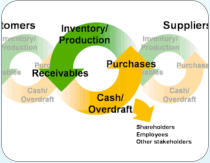



Working Capital as Barometer of
Efficiency
Doing it right, Working Capital Management is much more than
just tuning the receivables. It is THE indicator for optational
efficiency!

Working Capital is a highly efficient
barometer for measuring a
companies operating efficiency and
effectivity. As better the conditions
are, as more the corporate is able
to concentrate on its core-
business instead of asking banks
and shareholders for more capital.
The first shots to maximize cash management have their roots in the
beginning 70’s of the last century. But also today, almost 45 years
later, some companies don’t recognize that “tied capital” in the current
assets could be better used to run a successful business vs. their
competitors in the highly competitive market. There are clear
indicators that this important topic became now also attantion not only
in the financial departement, also in the awareness of the CEO. So far
the survey-results of large consultant firms.
Current results show an ongoing decrease of working capital in US-
and European corporates. In comparison to former years it monitors a
decrease between 3% and 5% what means, it has improved. This
demonstrates the increasing importance of working capital
management that corporates can better achieve their strategic results
(source: T. Loneux, REL Consulting).
While the improvements in Europe where larger than in the USA, the
trend shows that in general a softening of growth. This is a result
because traditional methods come to an end to generate value.
Hence, this leads corporates to think also outside established
processes and the increasing efforts of unfreezing liquid parts of the
balance sheet with creative new methods.
Course of Action
Advisory in the working capital management means not only to tell a
company that their debtors need to be forced for utmost fast payment
or to delay the vendor payments as much as possible and, last but not
least, decrease the inventory turnover to the smallest possible value
(days), i.e. increase it to its maximum. A well understood and
managed program for improvement concentrates without doubts on
optimizing every single part of it. But it shall provide additional benefit
which is going far above “normal” operational action. It shows the
necessity of ambitous companies to integrate working capital
management in the strategic and tactical thinking, instead investing
time and money in cost-optimizing projects which results at the end of
the day in marginal profits - if so.
There are numerous "dos" and "don'ts" which help to drive
management thinking. First, think on working capital management as
strategic goal which can achieve strategic operational goals of your
company. This is a very important step and need to be absolutely
respected. The same triggers which affect working capital
management, affect also your operational costs and customer
services. As a consequence that it contains als the components of
working capital, it is direct related to improve the operational costs
and the customer and vendor service.
For example the working capital of a company worses in case of
increase of overdue receivables of your customers. Now, if customers
do not pay in time it has mostly a specific reason which can often be
considered as disaffection. So, the question is now, why the
customers are not satisfied. An individual solution for many single
open- and still customer complaints takes in average 30 days time. By
trying to get to the bottom of the disaffection you can find out, whether
it is the price and/or the quality of the products or whether it is the
customer service which leads the customer to pay too late. This leads
to less tied time of your sales staff, in the order process and in the
account receivables department. These persons can now invest more
time in their core business, i.e. selling products, enter orders into the
system and lean accounting of cash collections. In consequence, the
productivity increase, the operational costs reduce and the sales
maximize. And this all, because the focus was to optimize a balance
sheet number called working capital and the project was to ask for the
reasons why customers do not pay their invoices in time.
This example monitors, how working capital is one of the best
indicators of underlying economic inefficency within an organisation.
Due to this reason it is quite important that the upper management
concentrate on the analysis of basic problems in working capital to
manage the operational costs better and to stay competitive in the
market. Some further ideas which are described below could be
broader to support the success.
Review from another point of view
Don’t think on things only from the point of view in your own company.
If you could help your customer to plan his warehouse more efficient,
you could for example merge this
improvement with the need of the
customers of your customer and
increase so your sales. Do this in
the same matter and cost efficient
with your own supplier. The
optimization possibilities for
inventory are huge. Because you
adjust inventory, production- and distribtution processes, you increase
the related performance and achieve immediately direct cost
reduction as side effect. Just after this discuss with your supplier and
customer better ways of delivery conditions. Learn your organisation
to make compromises between the different wishes of your customers
and suppliers and consider them as direct related. Depending on the
demand of a specific commodity it can be for example very attractive
for both parties (you and the supplier), to arrange a consignment
stock and get in contrary better settlement conditions. This could be
especially possible for goods which have a long production time and
request high minimum order quantities. Same criterias can be
adapted for a customer. Is it possible that a vendor driven stock could
help your customers to match his purchases exactly to his consume in
order to optimize a better plan for the production? However, it need to
be considered that this is not always possible for all products and
need to be analysed from case to case.
Negotiate formal Sales Conditions
Negotiate formal sales conditions with vendors and customers and
documentate them very carefully. Keep them always up to date and
take care that, without any exempetion, all employees are informed
about that. Especially those are responsible for purchase, sales and
administrative backoffice work (e.g accounts receivables / payables).
Do not agree to introduce a new product without a clear product-offer
management strategy. Whether you are in the consuming goods
industry or in the production of steel beams, today in the market many
firms count always on new products with the objective to keep their
market share or to growth. The problem is that poor product offer
management results in ineffeciency of the supply chain. A common
approach is also to support old products with large volumes on stock,
which do not find any more demand. This increases the operational
costs dramatical and let the organisation suffer under long standing
inventory volumes which need be eliminated. Did you already
calculated what is more expensive for you: loss of a sale or holding a
specific number of goods on stock? (See also our mathematical
model to calculate the ideal number and read our article “Supplier
Management”)
Collect your Cash
Don’t forgett to collect your cash. Many organisations introduce
powerful and ongoing recivable management systems in order to
prevent excess and overdue cash or cumulation of old debtors. Ask
your customers whether your invoices have been received and
whether they are clear for settlement. If not, notice the problems
which prevent a payment in time. Confirm and reconfirm the credit
conditions which have been agreed with your customer (see
especially for this topic our article Electronic Invoicing). The credit
conditions are going to be often lost in the translation of standard
payment terms and what is given in the standard data of the account
receivable general ledger. Dedicate the necessary time and attantion
for critical conflict management with customer complaints (quite and
open). Keep all customer and vendor complaints in a formal way.
Debates with customers freeze cash, reduce productivity and lead to
a poor service level.
Do not introduce top-down goals for all business processes overall.
For example many companies have a target of a 10% reduction of
working capital for every department. This may paralyse possible
optimization opportunities with a department and results in a stop of
efforts to fulfill impossible goals. Last but not least a general order can
also demotivate single employees, because he see this goal as unfair
as he self reached these goals always, but not the whole department
in which he is working. Better is a mix and match of top-town goals
with individial bottom-up strategy if you are interested in having better
results throughout your company.
Goal-Motivation
Define goals in way that you get the desired reaction. Many
companies like to introduce motivation modells to improve the bad
payment moral of the customers from for example 60 days. Does it
mean now that customers who pay between 1 and 60 days too late
are good customers? No, oustanding receivables of 60 days cause
higher costs and produce expenditure of time to collect the debt. By
instructing staff to reduce the time of 60 days you reduce your costs.
For example, a purchase manager can be measured and
compensated by the wholesale price but he has basically no intention
to increase the inventory cycle as he could include purchase quantity
and frequency consciously as a kind of joint venturer in his
decissions. Train your employees, customer and supplier who are
responsible for in- and outflow of your liquidity that they are a
constitutive part of a successful business relationship.
Look into yourself
Don’t assume that all answers can be found. Before you include
existing customers and supplier into negotations in order to arrange
payment conditions you need to understand first your own payment
processes. Hence, you are able to discuss bad payment processes
authentic. Negotiate with your supplier as you like that your
customer negotiates with you. A really larger benefit from cash
cycle can be strategically achieved with a leverage of your
relationship with customers and suppliers as it could be with a
intransigent attitude. Additional a supplier probably agree to support
you in case of need if you trade fair with him (this means not
compliant). In the same way a customer will excuse a mistake if you
both have set-up a strong business relationship.
But do not treat everybody same. Apply tactical segments to put
your customer and supplier in similar clusters. This may be a basket
of criterias including productivity, sales, outstanding items, overdue
debt, average order quantity and frequency. Define a strategy for
every cluster which is enlarged for the criterias of your strategic goals.
For instance you should reduce the management costs which
occurred from customers with low margin. You can achieve it as you
change the service levels and automatise the dependencies. Finally
allocate the capital equipment to the different clusters. The goal is
always to maximize the result. Celebrate the success if you hit the
goals. Highlight the action which helped you to get there. Ask your
staff how they reached their goals when they are already in the
following month or quarter. Briefly: motivate yourself to top the
achieved goals.
Summary
To summarize it shortly: the “dos” and “don’ts” help you to optimize
your cash and monitor the economic inefficiency in your processes
which need to be improved to render besser services to your
customers. They allow you to build a stronger participation with your
vendors throughout the supply chain of the whole working capital.
This ends finally in the improvement of basic results. Often quite
sooner as you expected and helps to illustrate the strategic approach
of the higher management.
Contact us, we would be glad to show you the possible
opportunities!
barometer for measuring a
companies operating efficiency and
effectivity. As better the conditions
are, as more the corporate is able
to concentrate on its core-
business instead of asking banks
and shareholders for more capital.
The first shots to maximize cash management have their roots in the
beginning 70’s of the last century. But also today, almost 45 years
later, some companies don’t recognize that “tied capital” in the current
assets could be better used to run a successful business vs. their
competitors in the highly competitive market. There are clear
indicators that this important topic became now also attantion not only
in the financial departement, also in the awareness of the CEO. So far
the survey-results of large consultant firms.
Current results show an ongoing decrease of working capital in US-
and European corporates. In comparison to former years it monitors a
decrease between 3% and 5% what means, it has improved. This
demonstrates the increasing importance of working capital
management that corporates can better achieve their strategic results
(source: T. Loneux, REL Consulting).
While the improvements in Europe where larger than in the USA, the
trend shows that in general a softening of growth. This is a result
because traditional methods come to an end to generate value.
Hence, this leads corporates to think also outside established
processes and the increasing efforts of unfreezing liquid parts of the
balance sheet with creative new methods.
Course of Action
Advisory in the working capital management means not only to tell a
company that their debtors need to be forced for utmost fast payment
or to delay the vendor payments as much as possible and, last but not
least, decrease the inventory turnover to the smallest possible value
(days), i.e. increase it to its maximum. A well understood and
managed program for improvement concentrates without doubts on
optimizing every single part of it. But it shall provide additional benefit
which is going far above “normal” operational action. It shows the
necessity of ambitous companies to integrate working capital
management in the strategic and tactical thinking, instead investing
time and money in cost-optimizing projects which results at the end of
the day in marginal profits - if so.
There are numerous "dos" and "don'ts" which help to drive
management thinking. First, think on working capital management as
strategic goal which can achieve strategic operational goals of your
company. This is a very important step and need to be absolutely
respected. The same triggers which affect working capital
management, affect also your operational costs and customer
services. As a consequence that it contains als the components of
working capital, it is direct related to improve the operational costs
and the customer and vendor service.
For example the working capital of a company worses in case of
increase of overdue receivables of your customers. Now, if customers
do not pay in time it has mostly a specific reason which can often be
considered as disaffection. So, the question is now, why the
customers are not satisfied. An individual solution for many single
open- and still customer complaints takes in average 30 days time. By
trying to get to the bottom of the disaffection you can find out, whether
it is the price and/or the quality of the products or whether it is the
customer service which leads the customer to pay too late. This leads
to less tied time of your sales staff, in the order process and in the
account receivables department. These persons can now invest more
time in their core business, i.e. selling products, enter orders into the
system and lean accounting of cash collections. In consequence, the
productivity increase, the operational costs reduce and the sales
maximize. And this all, because the focus was to optimize a balance
sheet number called working capital and the project was to ask for the
reasons why customers do not pay their invoices in time.
This example monitors, how working capital is one of the best
indicators of underlying economic inefficency within an organisation.
Due to this reason it is quite important that the upper management
concentrate on the analysis of basic problems in working capital to
manage the operational costs better and to stay competitive in the
market. Some further ideas which are described below could be
broader to support the success.
Review from another point of view
Don’t think on things only from the point of view in your own company.
If you could help your customer to plan his warehouse more efficient,
you could for example merge this
improvement with the need of the
customers of your customer and
increase so your sales. Do this in
the same matter and cost efficient
with your own supplier. The
optimization possibilities for
inventory are huge. Because you
adjust inventory, production- and distribtution processes, you increase
the related performance and achieve immediately direct cost
reduction as side effect. Just after this discuss with your supplier and
customer better ways of delivery conditions. Learn your organisation
to make compromises between the different wishes of your customers
and suppliers and consider them as direct related. Depending on the
demand of a specific commodity it can be for example very attractive
for both parties (you and the supplier), to arrange a consignment
stock and get in contrary better settlement conditions. This could be
especially possible for goods which have a long production time and
request high minimum order quantities. Same criterias can be
adapted for a customer. Is it possible that a vendor driven stock could
help your customers to match his purchases exactly to his consume in
order to optimize a better plan for the production? However, it need to
be considered that this is not always possible for all products and
need to be analysed from case to case.
Negotiate formal Sales Conditions
Negotiate formal sales conditions with vendors and customers and
documentate them very carefully. Keep them always up to date and
take care that, without any exempetion, all employees are informed
about that. Especially those are responsible for purchase, sales and
administrative backoffice work (e.g accounts receivables / payables).
Do not agree to introduce a new product without a clear product-offer
management strategy. Whether you are in the consuming goods
industry or in the production of steel beams, today in the market many
firms count always on new products with the objective to keep their
market share or to growth. The problem is that poor product offer
management results in ineffeciency of the supply chain. A common
approach is also to support old products with large volumes on stock,
which do not find any more demand. This increases the operational
costs dramatical and let the organisation suffer under long standing
inventory volumes which need be eliminated. Did you already
calculated what is more expensive for you: loss of a sale or holding a
specific number of goods on stock? (See also our mathematical
model to calculate the ideal number and read our article “Supplier
Management”)
Collect your Cash
Don’t forgett to collect your cash. Many organisations introduce
powerful and ongoing recivable management systems in order to
prevent excess and overdue cash or cumulation of old debtors. Ask
your customers whether your invoices have been received and
whether they are clear for settlement. If not, notice the problems
which prevent a payment in time. Confirm and reconfirm the credit
conditions which have been agreed with your customer (see
especially for this topic our article Electronic Invoicing). The credit
conditions are going to be often lost in the translation of standard
payment terms and what is given in the standard data of the account
receivable general ledger. Dedicate the necessary time and attantion
for critical conflict management with customer complaints (quite and
open). Keep all customer and vendor complaints in a formal way.
Debates with customers freeze cash, reduce productivity and lead to
a poor service level.
Do not introduce top-down goals for all business processes overall.
For example many companies have a target of a 10% reduction of
working capital for every department. This may paralyse possible
optimization opportunities with a department and results in a stop of
efforts to fulfill impossible goals. Last but not least a general order can
also demotivate single employees, because he see this goal as unfair
as he self reached these goals always, but not the whole department
in which he is working. Better is a mix and match of top-town goals
with individial bottom-up strategy if you are interested in having better
results throughout your company.
Goal-Motivation
Define goals in way that you get the desired reaction. Many
companies like to introduce motivation modells to improve the bad
payment moral of the customers from for example 60 days. Does it
mean now that customers who pay between 1 and 60 days too late
are good customers? No, oustanding receivables of 60 days cause
higher costs and produce expenditure of time to collect the debt. By
instructing staff to reduce the time of 60 days you reduce your costs.
For example, a purchase manager can be measured and
compensated by the wholesale price but he has basically no intention
to increase the inventory cycle as he could include purchase quantity
and frequency consciously as a kind of joint venturer in his
decissions. Train your employees, customer and supplier who are
responsible for in- and outflow of your liquidity that they are a
constitutive part of a successful business relationship.
Look into yourself
Don’t assume that all answers can be found. Before you include
existing customers and supplier into negotations in order to arrange
payment conditions you need to understand first your own payment
processes. Hence, you are able to discuss bad payment processes
authentic. Negotiate with your supplier as you like that your
customer negotiates with you. A really larger benefit from cash
cycle can be strategically achieved with a leverage of your
relationship with customers and suppliers as it could be with a
intransigent attitude. Additional a supplier probably agree to support
you in case of need if you trade fair with him (this means not
compliant). In the same way a customer will excuse a mistake if you
both have set-up a strong business relationship.
But do not treat everybody same. Apply tactical segments to put
your customer and supplier in similar clusters. This may be a basket
of criterias including productivity, sales, outstanding items, overdue
debt, average order quantity and frequency. Define a strategy for
every cluster which is enlarged for the criterias of your strategic goals.
For instance you should reduce the management costs which
occurred from customers with low margin. You can achieve it as you
change the service levels and automatise the dependencies. Finally
allocate the capital equipment to the different clusters. The goal is
always to maximize the result. Celebrate the success if you hit the
goals. Highlight the action which helped you to get there. Ask your
staff how they reached their goals when they are already in the
following month or quarter. Briefly: motivate yourself to top the
achieved goals.
Summary
To summarize it shortly: the “dos” and “don’ts” help you to optimize
your cash and monitor the economic inefficiency in your processes
which need to be improved to render besser services to your
customers. They allow you to build a stronger participation with your
vendors throughout the supply chain of the whole working capital.
This ends finally in the improvement of basic results. Often quite
sooner as you expected and helps to illustrate the strategic approach
of the higher management.
Contact us, we would be glad to show you the possible
opportunities!